| T O P I C R E V I E W |
| MauiBuilt |
Posted - 03/23/2012 : 10:51:07 AM
I currently play a yamaha fg700s, which I like, but am looking for something a little smaller (OM/000) with a wider nut. After reading a lot of reviews, i've heard good things about Recording Kings, and have my eye on the RO-10. ($300 is about my price range, too). Anyone here play one?
I'm bummed i missed out on the Silver Creek deals a while back, but oh well. For now I'm keeping an eye on elderly.com (since it seems like the place to order from), but hoping for a sale since the RO-10 is sitting at about $399.
Anyway, let me know your experience with this guitar. 
|
| 15 L A T E S T R E P L I E S (Newest First) |
| Ambrosius |
Posted - 04/17/2012 : 07:32:10 AM
quote:
Should have thought of that
Keo, I have to admit I'm more and more fascinated by the creation of fine instruments, so I hang out and lurks around a few of the luthiers forums.
Picks up a few things now and then  |
| GuitarVlog |
Posted - 04/14/2012 : 2:02:39 PM
quote:
Distance from nut to 12th fret x 2 is the best and most accurate way to measure the scale.
Should have thought of that!  |
| Ambrosius |
Posted - 04/14/2012 : 01:19:24 AM
quote:
On a slanted saddle, I don't know if you use the shortest, longest or middle point for measurement
Distance from nut to 12th fret x 2 is the best and most accurate way to measure the scale. |
| GuitarVlog |
Posted - 04/13/2012 : 2:08:02 PM
Scale length is the distance from the lower point of the nut to the contact point at the saddle. On a slanted saddle, I don't know if you use the shortest, longest or middle point for measurement.
From what I recall, the advantage of a shorter scale is lower string tension which makes fretting easier. I've heard players assert that shorter scales are more prone to intonation problems but that has not been my experience. I'd sooner blame a bad batch of strings.
Of course, if your hand can't stretch across the frets that well, a shorter scale will help with that. That's why some opt for shorter scale guitars.
Theoretically, longer scale lengths will result in higher string tension which also should produce more volume. However, I believe that the responsiveness of the guitar top and its construction are bigger contributors to volume than string tension. One luthier I know said that higher string tension can theoretically lower the volume of a guitar if the increased tension inhibits soundboard movement.
In the end, I recommend that you NOT get yourself bogged down in these kinds of details unless you have a good reason. Just play the instrument. If it speaks to you and it feels right, then it's the right one. |
| MauiBuilt |
Posted - 04/13/2012 : 08:48:47 AM
Wow, thanks for the info, GuitarVlog (this forum continues to impress!).
I'll definitely stick with light gauge strings on the RK. Like, you said, I think my fingers and ears are still getting used to the difference from the Yamaha. (I'm really loving the sound of the RK.)
How can I the scale length?--when I compare the yamaha and the RK face to face, they seem to be the same length, from nut to saddle. (What are the benefits of short scale vs. long(?) scale, particularly when it comes to slack key?)
Thanks again for all the advice.
BTW, in case anyone was interested, here's some quick pics:
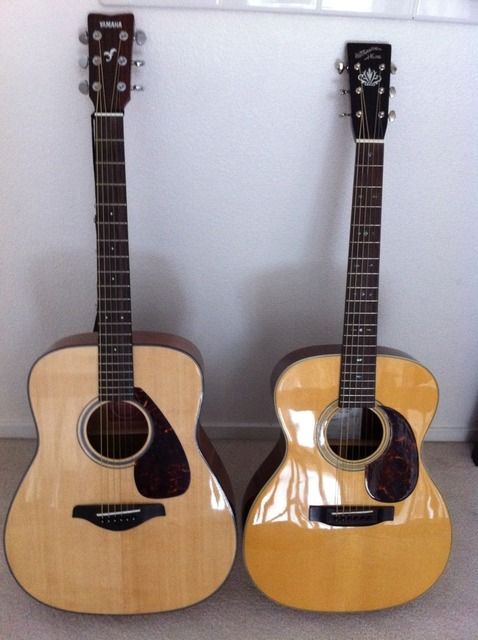
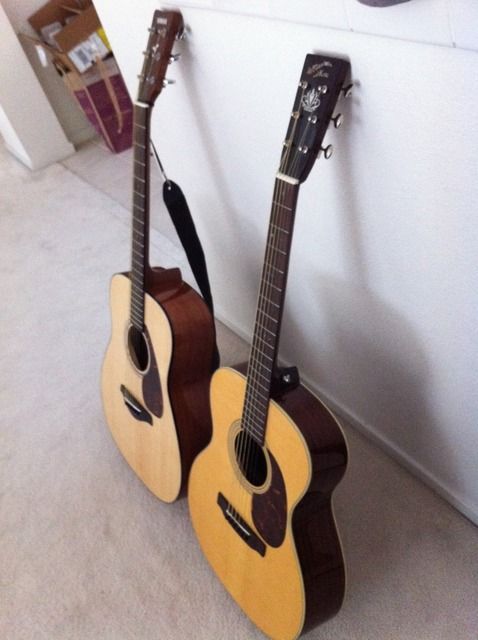
|
| GuitarVlog |
Posted - 04/11/2012 : 6:08:27 PM
Congratulations on your new guitar! May it bring you much happiness and satisfaction!
quote:
Originally posted by MauiBuilt
It also has lightweight strings which are interesting... My yamaha must have mediums because the strings on the RK by comparison feel much more "squishy". I like them so far, though I'm wondering about switching to medium lows in the future (the lows sometimes sound a little "tinny"?).
I have a Johnson Carolina II JO-27. This was the predecessor of the Recording King RO-27 which is the rosewood version of the RO-26 (which uses mahogany for the back and sides).
The lighter tension that you feel on the strings of the RO-26 may partly be due to the shorter scale of this guitar which is 24.9". Your Yamaha should have a scale of 25.56". Eric Schoenberg sold me my JO-27 and he advised me against using medium tension strings on it even with drop tunings. He did say I could use a medium tension 6th string if I were to keep the guitar in "Orkney" tuning (CGDGCD).
The Johnson Carolina II series was built to be very responsive and my understanding was that the tops were rather thin. Owners who used medium tension strings soon saw their guitars "bellying" as the bridge was pulled up by the tension. I don't know if the tops were thickened with the Recording King versions or the Silver Creek versions. Eric himself said that he preferred the JO-27 to the RO-27. We enlisted the aid of a professional guitarist and teacher to do a shoot-out between the JO-27 and two RO-27s. The former won and it is now mine.
Every guitar is different and I wouldn't be able to know if your RO-26 really sounds "tinny" or just sounds different compared to the tone of your Yamaha FG700S. You're comparing a smaller and shallower OM body to a dread body.
FWIW, I feel that my JO-27 has a strong bass, a lot of volume, and an evenness across all 6 strings. However, the guitar doesn't have the kind of tonal color and reverberations that I found in a Yamaha FG730S that I once owned. Much as I also liked the tone of my FG730S, I sold it because I developed a strong preference for guitars that have wider nut widths.
The 12th fret action on my JO-27 is 0.100" on the 6th and 0.090" on the 1st; higher than the average of 0.090" and 0.060" (aka 6/64" and 4/64" ... or "6-and-4 out the door" as techs call it). Eric and James recommended that action because I told them that I would be playing pieces in dropped tunings. I have dropped the tuning as low as BbFCFAC with no problems. |
| TerryLiberty |
Posted - 04/11/2012 : 08:14:19 AM
MauiBuilt:
Congratulations on the new box!!! Glad to hear it's sounding and feeling good to you. That's the final test, regardless of everyone elses' opinions.
I concur on the solid wood sound. When shopping for my instrument I hung the four final candidates up on the music store wall and strummed an open G chord on each to compare. The soild wood instrument just sang. It was an easy decision after that.
Have fun! |
| MauiBuilt |
Posted - 04/11/2012 : 07:40:15 AM
******UPDATE********
Thanks for all the advice guys! I was leaning towards the Seagull, but then a deal on a used RO-26 popped up that I couldn't pass on. I LOVE the recording king so far! The smaller body is a lot more comfortable, and it has a great sound. (Being somewhat new to guitars, it's amazing how different it sounds compared to my yamaha dread. The solid wood makes it surprisingly heavier than the larger dread too.)
It also has lightweight strings which are interesting... My yamaha must have mediums because the strings on the RK by comparison feel much more "squishy". I like them so far, though I'm wondering about switching to medium lows in the future (the lows sometimes sound a little "tinny"?). I'll leave it for now though to get used to it first.
I can see how buying guitars can be addicting. It's a lot of fun to switch between the two! (Who knows, a Seagull may find still find its way in to my possession if a good deal pops up on craigslist... :p ) |
| Curtis |
Posted - 04/04/2012 : 3:43:44 PM
I will echo what I've found at least one other person in the thread saying so far. With Recording Kings, I think you need to check them out before purchase, or at least make sure whomever you buy the guitar from has a good return policy.
I have played a few smaller bodied Recording Kings. While some are like playing dead wood others have a nice tone. The difference is more marked than with other brands. I have a Recording King tricone resophonic that sounds really nice, but it is being replaced because of a bad neck angle.
Curtis
|
| Ambrosius |
Posted - 03/31/2012 : 07:57:46 AM
quote:
It's advertized as 1.8 inches but measures 1.75
Terry, I did check this ... spot on 1.80 inches. |
| TerryLiberty |
Posted - 03/29/2012 : 05:12:19 AM
quote:
Originally posted by MauiBuilt
...but then i got worried that the 1.8" nut width might be TOO big....
I wouldn't worry too much about the neck width if my Seagull is any indication. It's advertized as 1.8 inches but measures 1.75. At first I was a little disappointed in the missing 50/1000 inch but it hasn't seemed to make a big difference.
Regards. |
| MauiBuilt |
Posted - 03/28/2012 : 7:10:17 PM
Thanks guys, maybe I'll turn my attention back to the seagull coastline folk. This was my main contender originally, but then i got worried that the 1.8" nut width might be TOO big. (Plus I was worried about the semi-gloss finish and my overly sweaty hands.)
The other tempting option is a used RO-26 or RO-27...
So many choices... |
| TerryLiberty |
Posted - 03/28/2012 : 05:15:53 AM
Jack:
Thanks for the thoughts. Actually, I bought this guitar at a store, not on the Internet. The store doesn't have any skilled luthiers available and Brady Anderson, the only one in town is a very busy guy so I'm doing it myself. It's working fine.
Regards. |
| slipry1 |
Posted - 03/27/2012 : 5:55:20 PM
Terry - in my experience, quality guitars come from the factory with high actions. After all, it's impossible to raise the action except by replacing the nut and/or saddle. Most of the stores that I've dealt with will set up a new guitar for free, which is a good reason to buy a guitar in a store. So, when you buy a guitar over the Internet, you have to set up the action yourself or pay someone to do it. Before you replace the nut, get a set of pattern files and file down the slots until the action is where you want it. Careful, though; if you go to fast you may go too far. |
| TerryLiberty |
Posted - 03/27/2012 : 2:21:11 PM
With one reservation, I'm very satisfied with my Seagull Maritime SWS (Solid Wood Series) Rosewood SG. It plays and sounds great, feels well made and I've had good response from their support folks. The one thing that needs changing is that the setup from the factory was high and I've been working on lowering the action by shaving the bridge saddle down. This is working but it's extra time and effort. Of course this guitar is not an OM/OOO style but a dreadnought without a cutaway. If you want a more traditional style instrument there's the Maritime SWS Folk HG. I suspect the quality, fit and finish would be very good on the the folk model too.
Good luck in your search! |